



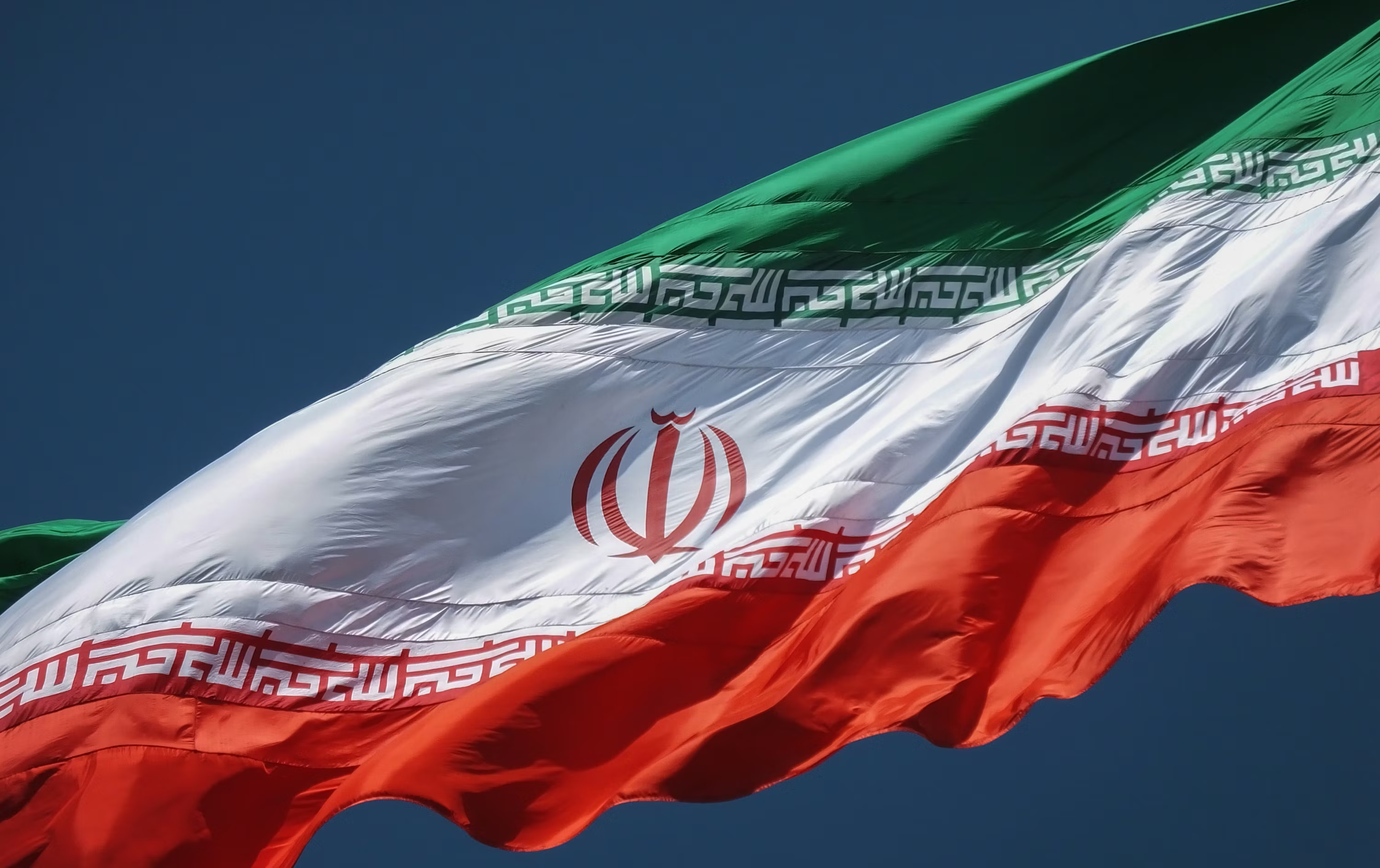

by Emil Guillermo
At the Winter Olympics, especially after that Men’s Hockey final, all Americans figuratively draped themselves with the flag, heads weighed down by Olympic gold. (Not the most in all the world, but enough to bow in gratitude).
Is it enough to make us act like one country again? Let’s hope so. That’s the enduring takeaway of the Olympics. We are all on the same team.
You win and celebrate with joy. You lose to another country and you still celebrate as an Olympian lucky enough to compete.
You don’t throw a tantrum at the world or say the contest was rigged. Are you listening Mr. President?
The relevant lesson for him is, you can’t use tariffs as a weapon to beat countries into submission. And you listen to the rule of law. You don’t call the Supreme Court justices–who voted that your tariffs were illegal—“embarrassments to their families.”
You also don’t start a war with Iran. Not without making the case to the public. Certainly not without Congressional approval.
If as the NBC promo insists, “for two weeks, we are on the same team,” I hope the idea sticks and we can move toward closing the divisions that threaten this country.
You know the president was watching. I hope he learned something. Somehow, I doubt it.
Final Day Thoughts —From Hockey To Gu
On the last day of the Olympics, I was up early watching the U.S. Olympic Men’s Hockey Team.
There were no Filipinos or Asian Americans. But so what? This was America’s team. We are Americans. And that’s the point of the games. They were representing us. All of us. That was my team. It didn’t exactly look like us, but the team was built by the cabal that is U.S. hockey. They know hockey, I don’t.
But the team could have included Filipino Asian American Jason Robertson, a stalwart with the Dallas Stars, and one of the leading scorers in the NHL.
Merit didn’t get him picked.
Where was affirmative action when we really needed it? Merit meant nothing? It boils down to who defines “merit”? Coaches will say they picked players for certain roles, styles of play, team chemistry. But there was legacy too. Brothers from a family of Olympic coaches. Olympic blood lines. Diversity meant nothing. Good players were left out.
Somewhat different on the women’s team where diversity had a historic and incidental role. Laila Edwards was the first Black woman to represent the U.S. in Olympic women’s hockey history. But there was no shortage on merit. Edwards’ inspiring play resulted in two goals and six assists in 7 games, including an assist on the goal that sent their gold medal game into overtime.
So just as I rooted for the women, I rooted for the men. It didn’t help that my current favorite hockey player, the San Jose Sharks’ star Macklin Celebrini was now the villain skating for Team Canada, hammering away at the U.S. in the final minutes of regular time.
But this is the Olympics. May the best team win. After three periods of hockey, the U.S. men looked gassed. But in the overtime, we didn’t have to wait long.
With the puck to the left of the Canadian goal, the USA’s Jack Hughes came down the right side uncovered. Hughes took the pass from teammate Zach Werenski to shoot the game winner through the five hole. (I visited Canada for six weeks last summer. I know the five hole).
The U.S. won. All of us. Pass out the medals and the stuffed animals. Play the anthem. That’s our song.
The Gu-lympic Question
After the hockey, NBC broadcast the delayed women’s free-ski half-pipe, a must see in every Tiger Mom’s weekend schedule. It featured two American-born Stanford students—not competing for the U.S.
Zoe Atkin, born in the U.S. to a British father and a Malaysian mom, was skiing for the Brits.
But all eyes were on Eileen Gu, the defending Olympic champion in the event, famously born in San Francisco to a Chinese mom and an American father. And competing for China.
There wouldn’t be an issue about representing your family’s ancestral lands since most of the time we aren’t talking about the “best of the best” athletes.
These are athletes who just want to breathe Olympic air.
That makes it the Olympic version of “affirmative action.”
This year there was Tallulah Proulx, 17, a Filipino American from Park City, Utah who was the first female athlete to represent the Philippines.
In the ‘80s I knew the first Filipino American man, Ray Ocampo, who did the luge for his family’s country. The Oracle star attorney lost for once in his life. But he won too. From then on, he could be rightfully called an Olympian.
This year, Proulx finished 50th in the slalom and 52nd in the giant slalom.
That’s the way it’s supposed to work when you compete for your mom and dad’s country.
It’s OK because you didn’t win, sure. But it also allows small countries like the Philippines that don’t have the resources to get representation at the games.
No one expects a longshot like Proulx to win a medal, let alone win gold. But Gu is different. She is a legitimate world-class champion. Gu who defended her free-style event title Sunday and became the most decorated Olympic freestyle skier ever. In two Olympics, Gu has six medals in all, three gold and three silvers.
That’s six medals that went to Gu-China not Gu-America.
Made me think it’s too bad Jason Robertson, the Filipino American hockey player, couldn’t be part of the Philippines National Men’s Hockey Team.
If one only existed.
Gu’s Entitlement
I don’t begrudge Gu her medals. Really. I do admit to being a bit hard on Gu during the Beijing Games in 2022, mostly because of the overall protest against China and its treatment of the Uyghurs, who still face repression in China.
This time in Italy, it all seems normalized. I admit to being a little nostalgic when the Olympics were all about “amateurism.” These days money has spoiled everything in sports at every level. No one blinks an eye when it’s reported that the Chinese pay millions to Gu to represent China rather than the U.S.
And even though China does not offer dual citizenship, Gu has carved out a unique sense of entitlement. She’s seen as a “global citizen” who does what she wants, where she wants, when she wants, and for the highest bidder.
Of course, as an American, she is still afforded certain inalienable rights here that aren’t given to those in China. And if you’ve seen her interviewed, Gu practices those rights frequently. But as SF State Asian American Studies professor Daniel Phil Gonzales said to me this weekend, that all comes with a sense of “obligation” to one’s country.
“Obligation” can be seen as a sense of loyalty, or patriotism. And Gu chose China for the podium.
Frankly, I like Gu, a fellow San Franciscan. She’s smart and thoughtful. But she’s not draped in our flag.
After her victory, when she spoke to the media, the focus reportedly was on how she just learned about her grandmother’s death.
My sincere sympathies to her and her family. But it doesn’t change how I feel about her competing for China. And I don’t think I’m alone in my discomfort over Gu. And it has nothing to do with the millions she gets from China to be the face of winter sports there.
More important is how people post-Olympics, post-Gu will look at another Asian American face. Will they question our loyalties when gold isn’t on the line?
In the hostile environment of the U.S. where a dark face is seen as un-American, Eileen Gu becomes the 21st Century Olympic Model Minority.
Some wags even make the argument that Gu being opportunistic is really just the American way. Really? Like Donald Trump and his crypto-corruption?
By dwelling on Gu, I don’t mean to give short shrift to the other winning individual Asian American athletes. I cheered for Chloe Kim and Madison Chock, who skated with her husband, Evan Bates. And Oakland’s Alyssa Liu’s comeback Gold medal made me cry.
But that was a few weeks ago. As I write on the final day of the Olympics, it was all hockey and Gu. And I’m just not all goo-goo over Gu.
Yes, she’s the beautiful American-born , Louis Vuitton model, Stanford student, Olympic champion, millionairess. Every Tiger Mom and Dad’s dream, right?
But you can’t stop there. She’s an American bought and paid for who represents China.
And no matter what she says, something about that still doesn’t feel right.
EMIL GUILLERMO is an award-winning journalist, commentator, and stage monologist. He has written his weekly column on Asian American politics and culture since 1995. See his micro-talk show, Emil Amok’s Takeout on YouTube. And see his upcoming appearances at amok.com.
About Author


+ There are no comments
Add yours