
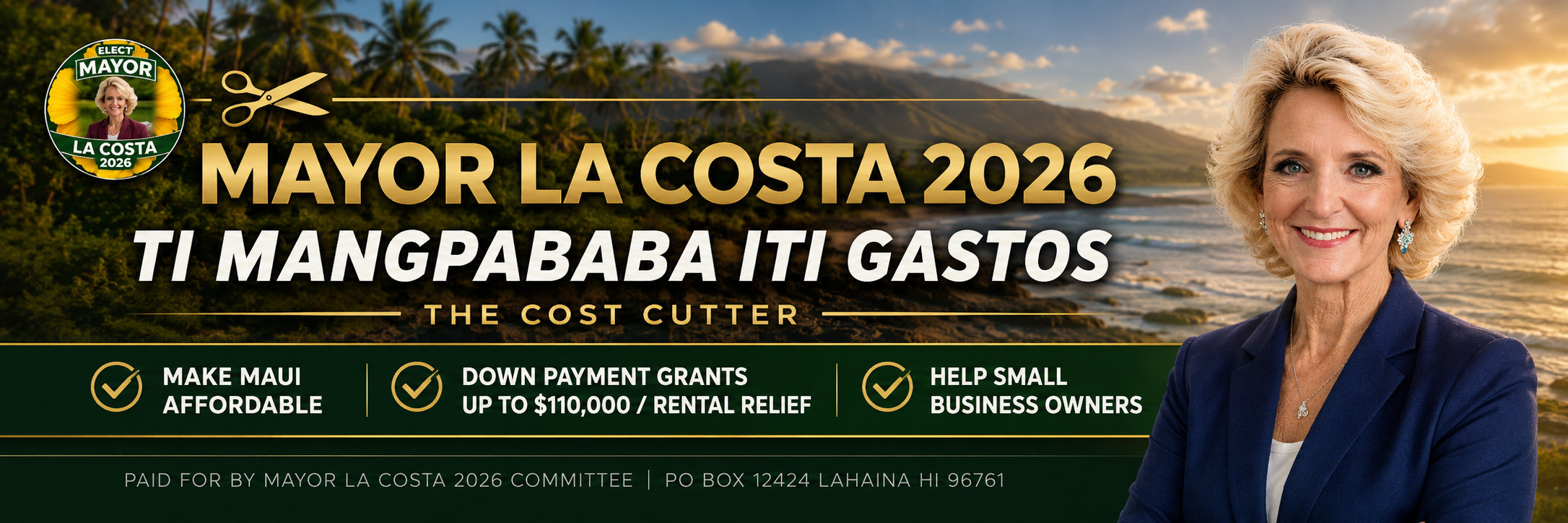


Hawaii’s primary election is on Saturday, August 8, 2026.
The primaries are a direct way for the parties to hear from the voters. You have the chance to choose a candidate you want to vote for, rather than having to settle for one someone else picks for you.
A millennial explained why voting is important. Ten passengers are on a bus. The bus driver gives them the choice: they can drive the bus to get ice cream or drive it over a cliff. Three votes for getting ice cream. Four votes to go off the cliff. The other three don’t make a choice and let the decision be made by majority rule.
Vote to show you care about government. Not voting is a sign that you are okay with the status quo.
When you vote, you are choosing someone whose policies will determine what laws they will approve, modify, or not approve.
Find out what the candidates’ values are and how involved they are in their communities, whether they are solution seekers, hardworking, able to understand other people’s viewpoints, respectfully try to reach common ground, and willing to compromise so the parties involved feel they have been given a fair shake.
Voting is your chance to elect officials who share your values and priorities.
In 1993, Bill Clinton tried to institute universal health care for all Americans, just as other developed countries have. Republican opposition killed his efforts. Despite significant opposition, Clinton signed the North American Free Trade Agreement (NAFTA) into law in 1993 to bring economic opportunities and jobs. From 1994 to 2000, NAFTA made Canada, Mexico, and the US into a free trade zone.
Clinton promoted families by signing the Family Medical Leave Act, which gave workers 12 weeks of unpaid, job-protected leave each year for qualifying events while maintaining health benefits.
Barack Obama and Joe Biden prioritized bringing down costs for Americans.
Obama gave tax credits for college tuition and for working parents. He pushed through the Affordable Care Act to bring down the cost of health insurance and expand Medicaid support for rural hospitals and health centers, so millions of Americans had access to medical care. His priority of keeping Americans safe led to the painstakingly negotiated JCPOA (Joint Comprehensive Plan of Action) to prevent Iran from developing nuclear weapons.
Obama saw economic strength as critical to our country’s well-being and negotiated the Trans-Pacific Partnership to make the US the lead trade partner in the Pacific Rim, where 40% of world trade takes place. He brought the US into the Paris Accord to combat global warming. When Ebola emerged, Obama created the task force, headed by Ron Klain, to contain the spread and avert an epidemic both globally and in the US.
Biden valued economic well-being for families. He negotiated caps on the ten most commonly prescribed medications, including $35/month caps for insulin and inhalers. He and Kamala were in the process of negotiating caps on the next set of commonly prescribed medicines. Biden directed his Department of Justice to break up monopolies that gouged people on prices (like Ticketmaster) and set his agencies to eliminate junk fees across different industries.
Biden made the US the leader in semiconductor chip production, bringing $100,000 jobs to states like Arizona. He championed livable wages across industries, raising the standard of living for families. Biden did “drill baby drill” to beat OPEC’s monopoly over gas prices. He increased the US’s strategic oil reserves to reduce US vulnerability to price hikes from oil-producing nations.
When you vote, you get to elect those who share your values so they can prioritize government action for the good of all.
Senator Mazie Hirono recently pointed out the very real importance of electing someone who values the people:
“$600 million for a vanity ballroom – $29+ billion for an illegal war – $300 billion to rebuild Iran – $14 million for an algae-infested pool (that Biden estimated cost $1.33 million) – But not a single penny for the 770,000 hungry kids in our country (SNAP benefits).”
Voting is convenient and easy – by mail, early, or in-person. Hawaii believes in people choosing the officials who govern them by making voting easy and accessible.
Voter Service Centers open ten business days before the election to offer accessible voting, in-person voting, and same-day registration. The voter service centers will be open from July 27 to August 8 for this year’s primary election. If you already asked for an absentee ballot, it should get to voters by July 21, 2026, so you have enough time to learn about the candidates and issues before the election.
Your vote counts!
The 2016 election wasn’t decided by Hillary Clinton’s large 2.8-million-vote gap over Donald Trump. Her loss was determined by 78,000 votes from only three counties in Wisconsin, Pennsylvania, and Michigan – just two votes per precinct. If just three voters in each of those precincts had cast their ballots, Hillary Clinton would have been elected instead of Trump.
The 2000 election was decided by only 537 votes out of the 5.96 million (a margin of 0.009%) cast in the state of Florida. This gave George Bush 271 electoral votes, one more than the 270 required to win. Al Gore won the popular vote by 543,895 (a margin of 0.52% of all votes cast).
The shape of our country changes by those who exercise their precious right to freely choose those who will govern us.
Your vote counts. Your vote makes it possible to elect candidates who share your values so they can prioritize policies that help us.
As the United States celebrates its 250th anniversary, its traditions remain strong. We can support these traditions by participating ourselves.
Vote! It is our right. It is our way of preserving our democracy.
About Author


+ There are no comments
Add yours