




by Edwin Quinabo
YEAR-IN-REVIEW: The following is a recap of top stories the Hawaii Filipino Chronicle covered in 2025 as cover stories, editorials, news or column contributions.
#1 Filipino community joins national movement pushing back against ICE’s tactics and politicization
Topping the list of news in 2025 and arguably forecasted to repeat in 2026 is the national movement against ICE, their questionable and oftentimes illegal tactics in carrying out President Donald Trump’s mass deportation agenda.
While all eyes are now on the twin cities of Minnesota – Minneapolis and St. Paul – and their resistance against ICE largely intensified by the killings by ICE agents of Renee Good and Alex Pretti, in 2025 ICE’s Operation Metro Surge swept through Los Angeles, Chicago, Portland, Boston, New York City, Seattle, and others, mostly all Democratic-majority cities. Critics say the raids were typically aggressive, excessive in force and frequently violated civil liberties. Significant controversies centered on racial profiling of people of color, entering homes without judicial warrants, creating chaos and confusion by ICE wearing masks and not identifying themselves properly, and targeting sensitive areas near schools, churches, hospitals and courthouses.

Filipinos both on the mainland and Hawaii spoke against the ICE raids. LA councilmember Ysabel Jurado, the first Filipino American elected to the Los Angeles City Council has been an advocate for immigrant rights for years. She said of ICE’s raids, “The footage speaks for itself. This is cruelty disguised as policy.”
Todd Gloria, San Diego’s first Filipino American mayor, said the raids at popular South Park, San Diego eateries create fear instead of security. Fil-Am Kenneth Mejia, LA City Controller called the raids “cruel” and expressed concern over the strain on city resources and the importance of accountability under sanctuary-city ordinances.
Attorney General Rob Bonta who along with Gov. Gavin Newsom has sued Trump for federalizing the National Guard without the governor’s consent. AG Bonta, the highest-ranking public official of Filipino ancestry in California, has spoken out against the ICE raids, calling them “unlawful” and “disrespectful.”
Community leader and Honolulu attorney Sergio Alcubilla stated that Trump’s deployment of federalized National Guard troops in response to protests was unnecessary and inflammatory. “It undermines our core democratic principles that our military will not be politicized.”
The Trump administration aims to detain 3,000 migrants a day, over one million a year. The Department of Homeland Security records show there are 350,000 unauthorized Filipino migrants residing in the U.S. as of 2022. The U.S. Census Bureau in the same year registers 4.1 million Filipino Americans in the U.S. Combine the two figures: about 8.5% of Filipinos in the U.S. are undocumented.
Alcubilla told the Hawaii Filipino Chronicle there is no question that the U.S. national immigration policy needs reimagination. “As previous administrations have shown, improvements that respect and maintain human dignity can be done while still following the rule of law and due process,” he said.
Tanggol Migrante Network is a Filipino immigrant rights group. Kami Yamamoto, the Interim Executive Director of Hawaiʻi Workers Center, a part of Tanggol Migrante Network, said “We encourage the Filipino community to reach out to the Tanggol Migrante network if they know of any Filipinos in distress.”
#2 Trump’s Denaturalization Plan and his ending Birthright Citizenship Executive Order
The anti-immigrant theme in 2025 had two other questionable Trump policies that emoted ire in immigrant communities, including the Filipino community.
DENATURALIZATION. First, a DOJ memo marks a radical expansion of the president’s immigration agenda, a new shift in his plans to “maximally pursue” denaturalization of American citizens. The June 11 memo states, “The Civil Division shall prioritize and maximally pursue denaturalization proceedings in all cases permitted by law and supported by the evidence,” the memo said, adding that it should be among the division’s top five priorities.
Legal scholars believe the recent DOJ memo is cause for concern because of its vague language could be weaponized to include whoever the Trump administration want to cast as not belonging here. Traditionally, denaturalization had been used in extreme cases on alleged enemies of the state, spies, war criminals or later to include those who committed fraud while applying to become a U.S. citizen.
Naureen Shah, director of government affairs for the ACLU’s Equality Division, said “anyone could be prioritized for denaturalization. It’s really chilling.”
Amanda Frost, a law professor at the University of Virginia and director of the university’s immigration, migration and human rights program, said “in theory, almost every naturalized citizen could be at risk. That’s because errors in the naturalization process could be construed broadly, and the labyrinthine road to naturalization is ripe for missteps. But it’s unclear if the government would actually bring a case based on minor omissions or mistakes.”
Raymund Llanes Liongson, Ph.D., retired college educator, a naturalized U.S. citizen, told the Hawaii Filipino Chronicle, “The Trump administration’s plan to revoke U.S. citizenship from naturalized American citizens is very concerning and disturbing. This raises several issues like the overreach of Executive Power, due process violation, erosion of democratic protection, separation of families, creation of fear and uncertainty among naturalized citizens. And with the vague standards and language, are citizens holding dual citizenship at risk as well?”
ENDING BIRTHRIGHT CITIZENSHIP. Second, as a matter of one of his first orders of business in his second term, Trump signed an executive order to end birthright citizenship in the U.S. for children of illegal immigrants as well as immigrants legally but temporarily present in the U.S. The executive order aims to challenge the prevailing interpretation of the Citizenship Clause of the 14th Amendment.
If Trump’s executive order is successful in the courts, it would not be retroactive but only apply to individuals born 30 days after the order was issued on February 19, 2025. On June 27, 2025, the Supreme Court decided on birthright citizenship limiting the ability of lower-court judges to issue universal injunctions to block such executive order nationwide. SCOTUS did not rule on the interpretation of the Citizenship Clause of the 14th Amendment. But on July 10, 2025, a New Hampshire federal district judge issued a preliminary injunction to prevent federal officials from enforcing the order nationally.
Liongson opined “These policies are not to make America great again. That motto is deceptive and false. In reality, these policies are designed to make America White again. The Trump immigration policies are consistent with the growing assertion of White supremacy across the country, and it is urgently imperative that the nation recognizes this. Such an assertion is racist, immoral, illegal, and un-American. I am concerned that under an authoritarian and racist regime, unless you are White, you are not safe.”
#3 One Big Beautiful Bill Act Becomes Law
The One Big Beautiful Bill Act (OBBA) was signed into law by Trump on July 4, 2025. It made a significant 12% cut to Medicaid spending and expanded work requirements for SNAP benefits recipients and made state governments responsible for some costs relating to the food assistance program. The law increases the funding for ICE from $10 billion to more than $100 billion by 2029, making it the single most funded federal law enforcement agency.
While Congress currently is wrangling with provisions of the OBBA like Medicaid cuts and ICE funding, the law remains the law of the land and as is could see: 1) at least 17 million Americans losing their health insurance because of changes to Medicaid; 2) hospitals and clinics, especially those in rural communities, experience high financial stress or close; 3) increase premiums, deductibles, and out-of-pocket expenses for most health insurance; 4) cause over 500,000 healthcare job losses; and 5) an estimated 3.2 to 22.3 million families nationwide – could lose some or all their SNAP (food stamp) benefits.
#4 States like Hawaii must scramble to close the gap of Medicaid cuts
The fourth top news covered by HFC is an expansion of the third and due to its gravitas, the Medicaid cuts in particular needed further exploration from a local angle. Medicaid is a joint federal and state health insurance program that provides health insurance to more than 71 million low-income and disabled Americans. Med-QUEST is Hawaii’s Medicaid program. Some 403,670 adults and children in Hawaii are enrolled in Med-QUEST.
U.S. Senator Brian Schatz (HI) told the Hawaii Filipino Chronicle, “More than 400,000 people in Hawaii, which include nearly half of the children in our state, rely on Med-QUEST. It’s a safety net program that’s supposed to protect the most vulnerable in our community. These proposed cuts from Republicans will take health care from people who need it most. It’s cruel, it’s un-American, and we are going to do everything we can in the Senate to stop this from happening.”
Dr. Rainier Dennis Bautista, President of the Philippine Medical Association of Hawaii (PMAH), said about 60,987 or 14.8% of Med-QUEST members are Filipinos. He told the Hawaii Filipino Chronicle, “Cuts to Medicaid would disproportionately impact our Filipino community, which has long relied on Med-QUEST for access to essential healthcare services. Many Filipino families include multigenerational caregivers, essential workers, and older adults managing chronic conditions. Losing coverage could mean losing access to medications, primary care, dialysis, and home-based services, thus putting thousands at risk.”
Dr. Bautista lays bare the human cost to Medicaid cuts — “the growing number of patients who will delay care, ration medications, or avoid the doctor altogether until their condition worsens, they will end up in the emergency room,” he said.
In Hawaii, federal funds cover 73% of the $3 billion spent annually on Medicaid. It provides health care for 1 in 3 keiki and covers 1 in 3 births in the state. Around 60% of adults on Med-QUEST are employed, often with multiple jobs. KFF said any reduction in federal Medicaid would leave states with tough choices on how to offset reductions. Based on analysis by the Center on Budget and Policy Priorities, Hawaii would have to raise taxes or cut other parts of its budget by an estimated $3 billion over 10 years to maintain Med-QUEST, including the Medicaid expansion to low-income adults. Hilton Raethel, president and CEO of the Healthcare Association of Hawaii, said all of Hawaii’s hospitals would be affected by Medicaid cuts, as all care for Medicaid patients.
#5 Trump tariffs hurt American consumers
Trump’s tariffs on Canada, China, and other countries started in the first quarter of 2025. The Economic Policy Institute says American households will bear most of the burden of tariffs in the form of higher prices on imported goods and for domestic goods that compete with imports.
Hawaii Governor Josh Green told the Hawaii Filipino Chronicle, “Tariffs are likely to increase costs for our people, so his [Trump’s] approach could really hurt Hawaii residents. Tariffs on our allies like Canada, many of whom come to Hawaii, seem poorly thought out. I also have serious concern that this approach will increase the cost of housing, because the cost of materials will soar. That’s the last thing we need.”
U.S. Rep Ed Case told the Hawaii Filipino Chronicle, “Under our trade laws, a President does not have full authority over whether and how to impose tariffs. Under our Constitution, Congress has the power to regulate commerce, and under our trade laws Congress has a specific role on tariffs as well. So, Congress always has the right under our Constitution to oversee the administration, partner with it on specific trade policies, and ultimately direct the administration through our lawmaking authorities.”
The Tax Foundation estimates that the tariffs will generate around $100 billion per year in extra federal tax revenue. But it also said not only could tariffs drive up consumer prices but eliminate hundreds of thousands of jobs and hurt businesses.
#6 Filipino community events: a focus on Latest Doctors-on-Stage Production
As it does every year, the Hawaii Filipino Chronicle covered Filipino community events from the annual Filipino Fiesta and Parade to club and professional association events.
In 2025, back to breathe life onto stage for charity was the 10th production of Doctors-on-Stage (DOS), produced by Dr. Charlie Sonido, who is also the concept originator of this year’s theme: “Love: Found & Lost, ‘It’s Better to Have Loved and Lost than Never to Have Loved at All.’” The event took place on April 26, 2025, at the Salvation Army Kroc Center Hawaii.
“This present production of a love that’s lost is a sadder side of love. The storyline reflects reality, that people fall in love and at some point, there is separation by death or divorce, followed by grief and the challenge to climb out of it, a journey toward redemption. This is real life,” Dr. Sonido said.
All Doctors-on-Stage productions are the main fundraisers for the Bayanihan Clinic Without Walls (BCWW), a clinic that offers free medical and dental services to newly arrived legal immigrants who cannot afford health insurance. “The proceeds from DOS helps to defray medical expenses of legal immigrants seeking healthcare,” said Dr. Sonido, a cofounder of BCWW, which is a non-profit community-based healthcare organization that was established by the Philippine Medical Association of Hawaii (PMAH) on April 17, 1997.
#7 Profiling Filipino Gen Z, their unique attributes and values
The HFC wanted to explore the Gen Z generation — individuals born between 1997 and 2012 (13 to 28 year old) – and found interesting results of Gen Z from their predecessors. Thrivingcenterofpsych.com found 85% of Gen Z do not feel marriage is necessary to have a fulfilled and committed relationship. More than 1 in 6 (17%) are not planning to get married. Gen Z tends to be politically progressive and unafraid to fight for systemic institutional changes. At the same time, they are also more open than Millennials and Gen X to religion. Rina Bird, a volunteer at the Young Catholic Adult Network, has seen this openness firsthand. “We are highly visible on social media, and so we are getting many new converts,” she says. “Particularly among young men in the 25 to 30-year-old age range.” A recent survey from YouGov and The Bible Society found that church attendance has increased by 50% in six years. And young people are leading this resurgence. Those aged 18-24 (within the Gen Z age bracket) are now the second largest demographic to attend church, with 16% saying they attend church once a month last year (second only to the 19% of those aged 65+).
Gen Zs concerns are affordability, the AI revolution and job insecurity. Gen Zer Ann Danelle Lucero, 27, Tustin, California, told the Filipino Chronicle, “I believe the future of the Filipino is bright and full of potential but will come with many changes as well. The younger generations are bridging old traditions with technology and new cultural advancements, blending cultural pride with creative expression through platforms like social media, podcasts, and online businesses. I can see a future of redefining the true meaning of being a Filipino in today’s world — proud, progressive, and not afraid to challenge the status quo while maintaining our deep-seated cultural values. Whether through healthcare, cultural work, or community engagement, I’m passionate about bridging the gap between generations and uplifting the next wave of Filipino voices.”
#8 Runaway healthcare prices saddle millions of Americans with medical debt and bankruptcy
According to a report by the Kaiser Family Foundation (KFF), over 100 million Americans—about 41% of adults—are dealing with medical debt. That’s nearly half the population, highlighting just how common and devastating this problem has become. Medical bankruptcy is the top reason why Americans file for bankruptcy, and it represents 66.5% of all personal bankruptcies, according to the American Journal of Public Health. The American Journal of Medicine found that 48% of those who filed for medical bankruptcy say their largest expense was the hospital bill. KFF found short-term hospital stays are what causes issues with medical bills in 66% of cases.
A report from the nonprofit Health Care Cost Institute found that the average person with employer-sponsored insurance spent $6,710 on health care in 2022. For a family of four, the average health insurance premium cost in 2024 was $25,572, combining employer and family contributions, according to KFF.
Dr. Jon Avery Go, Primary Care Clinic of Hawaii, says there are several reasons why some fall into medical debt, “factors that may include high insurance deductible that patients may end up postponing essential medical treatment and the severity of illness becomes more complex which later might require a higher level of care like hospitalization. In the end it will cost more to treat. Another cause of medical debt is lack of adequate medical insurance coverage that the patient ends up paying out of pocket.”
#9 The AI revolution is here, be prepared or get left behind
The Hawaii Filipino Chronicle explored the AI ecosystem; the future of work and jobs being shed in the new tech environment. According to Pew Research Center, 32% of U.S. workers fear their job will be replaced by AI or similar technology by 2025. Statistics show jobs have already been lost to AI. In May 2023, 3,900 U.S. job losses were directly linked to AI, making it the seventh-largest eliminator of jobs that month. Nearly 14% of U.S. workers report having lost their job to a robot or AI-driven automation. Since 2000, automation has resulted in 1.7 million U.S. manufacturing jobs lost.
#10 No more forever wars; Americans prefer addressing domestic issues
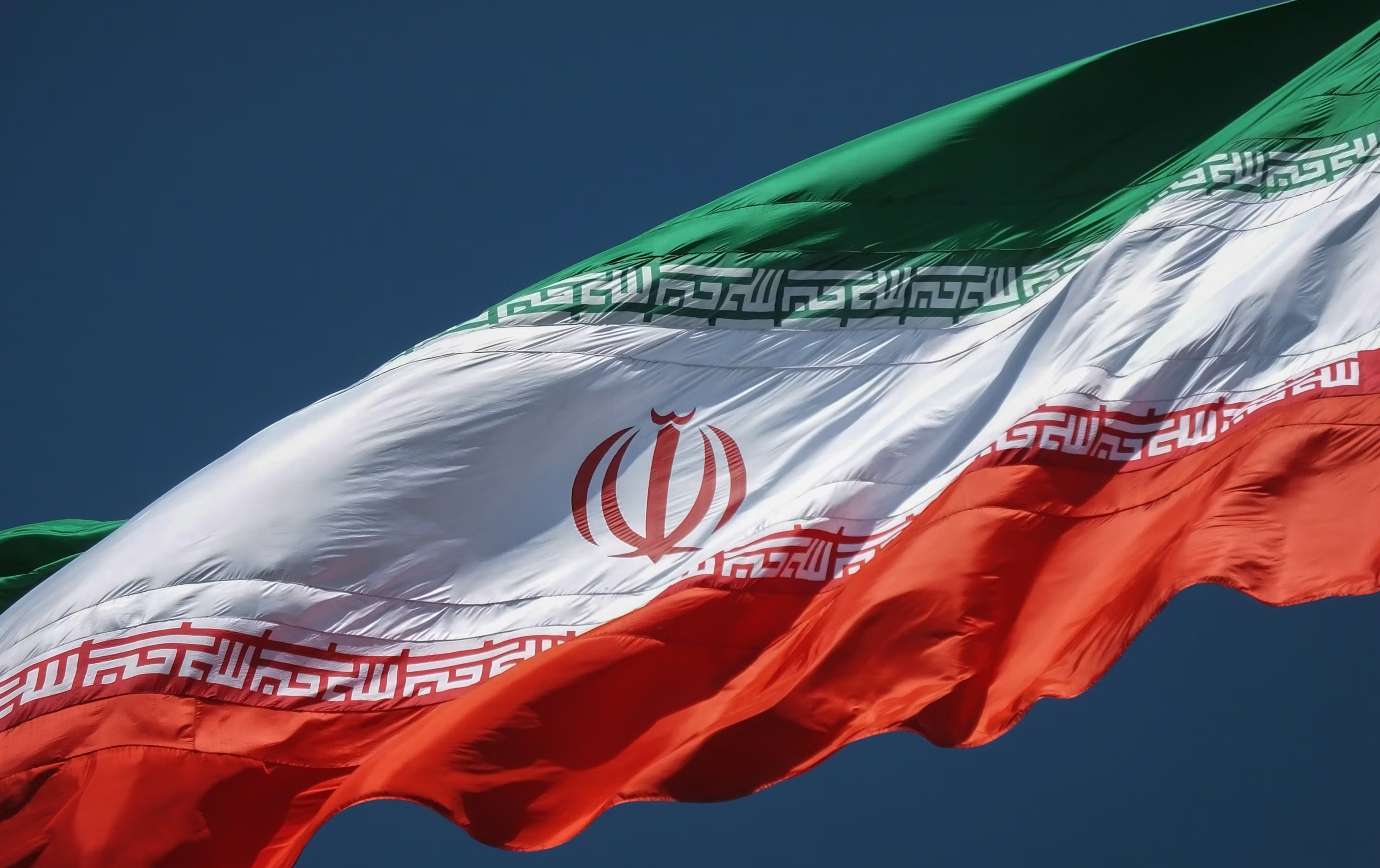
The cost of U.S. empire and forever wars has come at a heavy price and increasingly more Americans favor that government spend more on domestic needs than foreign adventurism. June 13, 2025, war breaks out between Israel and Iran. Israel attacks nuclear sites in Iran saying that it had no choice but to bomb because Iran was close to building nuclear weapons. Iran, which has claimed that it has been operating an entirely peaceful nuclear program only for civilian purposes – launches a counter strike sending missiles into Israel. June 21, 2025, previously only supplying weapons to Israel, the U.S. enters the conflict directly. Called Operation Midnight Hammer, U.S. military forces hit Iranian nuclear facilities at Natanz, Fordow and Isfahan using long-range bombers and Tomahawk cruise missiles.
Myrna Lim, a San Francisco based attorney and Television Producer for San Francisco Public Access, told the Hawaii Filipino Chronicle, “The U.S. spends approximately $1.2 trillion per year on the military, CIA, intelligence, Homeland Security, military aid to countries like Israel and Ukraine. Instead of alleviating poverty, the government creates the conditions for poor to become poorer and the rich get richer.”
Editor’s Note: Original articles of these top stories can be accessed in HFC’s archives of articles at www.thefilipinochronicle.com.
About Author


+ There are no comments
Add yours