



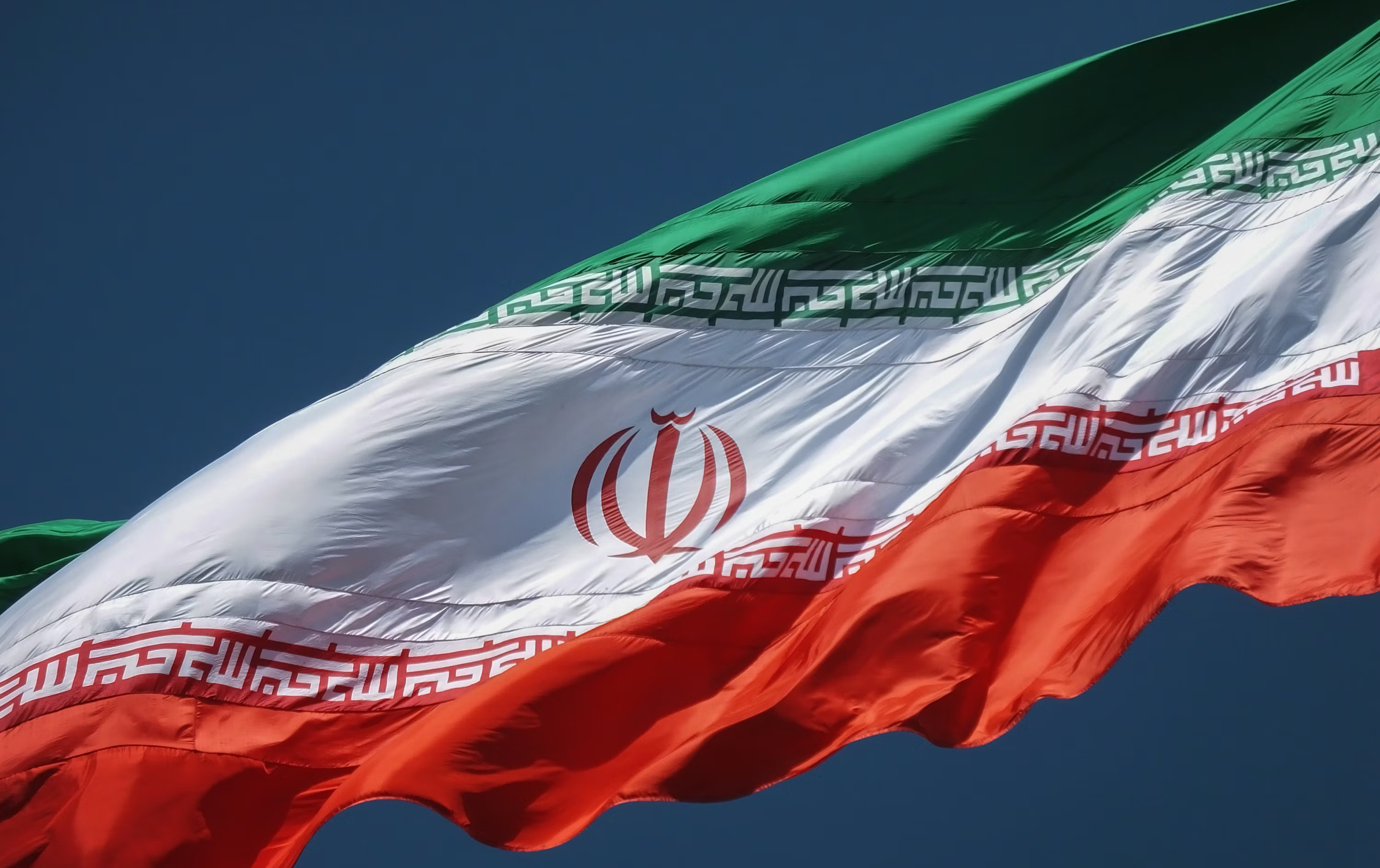

Iran is no friend to the United States – largely because of historical reasons and current sanctions against them – but U.S. intelligence (President Donald Trump’s own) as confirmed by US congressional members briefed in closed door meetings (reported by Reuters) showed two things: 1) there was no imminent threat that Iran was planning to attack US forces and that this preemptive strike on Iran 2) was a war of choice.
In addition, the head of the International Atomic Energy Agency (IAEA), Rafael Grossi, has said there is no evidence that Iran is currently building a nuclear bomb, while warning that unresolved issues surrounding Tehran’s nuclear program remain a serious concern, of which Tehran was in the midst of negotiation twice before being preemptively attacked by US forces.
Should we take the word of Prime Minister Benjamin Netanyahu who has been saying now for decades that Iran is within days or weeks of having nuclear bombs? Of course not.
As for the disingenuous weak justification for war that the US should be helping the Iranians achieve democracy in their own country. That’s odd when the US has multiple allies in the Gulf states that are monarchical, anti-democratic and have shady records of human rights violations.
The bottom line is that the US wants regime change to catapult a leadership in Iran that’s friendly toward the US and West, and one that will help to enrich US oil companies with better access and deal-making to benefit the US. As for Netanyahu, his goals differ from the US’, one perhaps more aligned to making Iran feeble, chaotic and similar to the aftermath of post-war Syria.
Beyond these goals the US also seeks to: 1) maintain global Empire supremacy over the competing superpowers of China and Russia (allies of Iran). China receives major quantities of oil from Iran. Russia gets massive amounts of cheap but highly effective drones to bolster its campaign against Ukraine. 2) render Iran into a weak shell which would hurt China, Russia, N. Korea and other BRICS members that collectively poses a legitimate challenge to US-West hegemony.
Americans might find this to be a valid justification, that US interests should be above other competing powers, but the stark, very stark reality, and geopolitical analysts already have been pointing this out: it is too late. There are two large centers of global powers: 1) the US and West, and 2) China and central (Russia) Asia/parts of Southeast and South Asia. It could be likened to a Cold War 2.0 but with new key chess pieces, namely China on top on the other side.
And in this new global geopolitical paradigm neither can defeat the other even with the use of nuclear weapons as the ultimate last resort.
Back to Iran, as mentioned above. It is the fourth (behind India), perhaps third major piece in the BRICS alliance, and it’s highly doubtful that it will succumb to the West as the West would want. The US could succeed in putting back Iran militarily. But whatever loses could be rebuilt with assistance from China and other allies just as whatever loses are inflicted upon Israel will be rebuilt by Western money streams.
Trump has no legal authority under the US Constitution
Article I, Section 8 of the United States Constitution is clear. Congress is vested with the power to raise and support armies, maintain a navy and, most importantly, “to declare war, grant letters of marque and reprisal, and make rules concerning captures on land and water.”
Trump violated the US Constitution and did not seek approval from the US Congress which makes this war an illegal war from the perspective of US law, independent from international laws which buttress this idea of illegality.
Israel’s influence on US foreign policy
It must also be addressed Israel’s influence on the US. From the words of Secretary of State Marco Rubio himself, it’s clear that the US in part was driven into this latest conflict because of Israel. Rubio said Israel was going to attack Iran and the US knew that meant Iran would counter strike American military bases. So, the US made a calculated decision to join Israel in their preemptive attack on Iran and to weaken Iran’s ability to launch counter strikes.
Given the overwhelming opposition to an attack on Iran by a majority of Americans, poll after poll confirms this, it’s undemocratic that Israel or any foreign nation has more of a say in US foreign policy than US citizens themselves.
House Speaker Mike Johnson confirms this preemptive attack calculus involving Israel. “Because Israel was determined to act with or without the US, our commander in chief and the administration and the officials [in the Cabinet] had a very difficult decision to make. They had to evaluate the threats to the US, to our troops, to our installations, to our assets in the region and beyond,” said Johnson.
This is not how an ally, Israel, should behave especially if the US will be making huge sacrifices in lives and cost in dollars for a war. Furthermore, the U.S. shouldn’t bypass its own constitutional system of government because Israel wanted to go to war with Iran.
Cost factor amid a country (US) in need
The last and arguably the most important point why this war – whether it’s ongoing or has ended by the time this editorial is printed – should not be fought is the obscenely and detrimentally (to the US) massive cost. The US does not have billions upon billions to spare for war. Just think about the cost of interception defense missiles costing millions each to shoot down Iranian drones that are far cheaper (just a few hundreds of thousands each to build) that Iranians can keep manufacturing by the tens of thousands. Do the math! This war is unsustainable, even immoral when millions of Americans are losing their health insurance and food security in order to trim the US federal budget.
About Author


+ There are no comments
Add yours